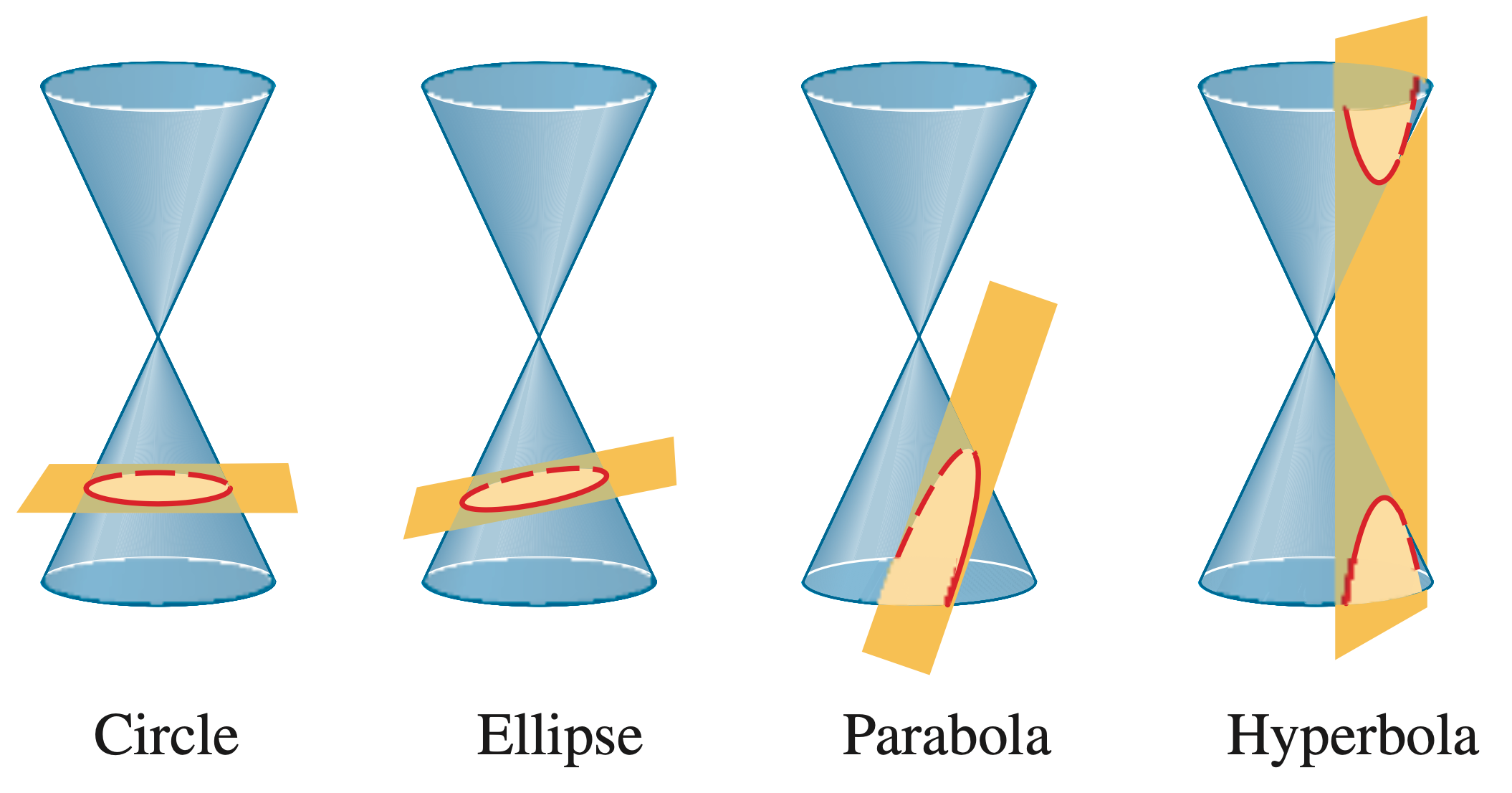
Conic sections are the curves formed when a plane cuts a cone, these include circles, ellipses, parabolas and hyperbolas, as shown in below figure. For example, the cross section is a circle if the cone is cut horizontally.
Parabola
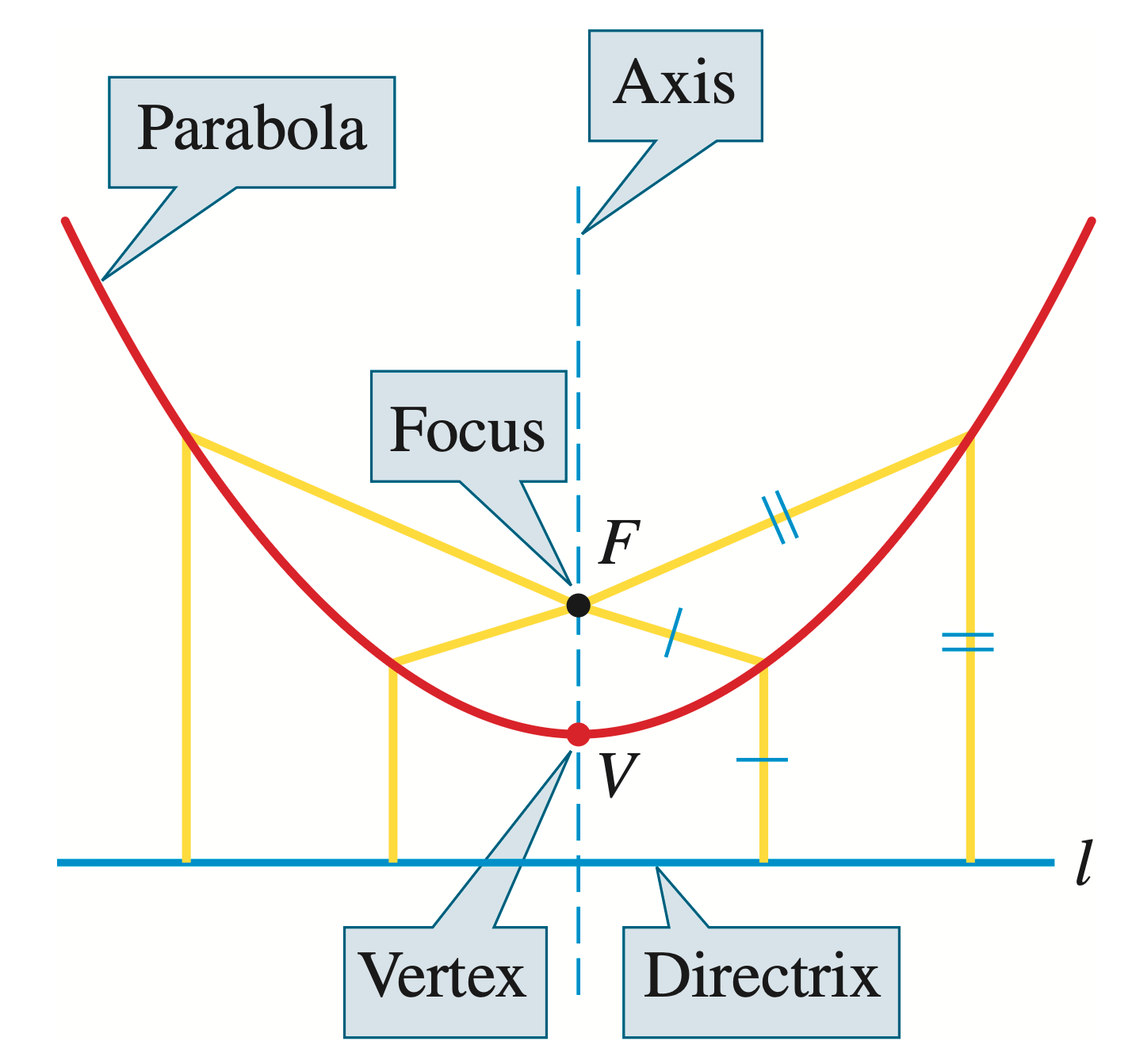
A parabola is the set of all points in the plane that are equidistant from a fixed point called the focus and a fixed line called the directrix. The vertex lies halfway between the focus and the directrix, and the axis of symmetry is the line that runs through the focus perpendicular to the directrix, illustrated below.
We first consider parabolas that are situated with the vertex at the origin . If the focus of such a parabola is the point , the axis of symmetry is vertical, and the directrix has the equation . Since any point on the parabola is equidistant from the focus and the directrix, we have
This is the standard equation of a parabola with vertical axis, focus at and vertex at the origin . Interchanging and results in a parabola with horizontal axis, focus at and vertex at the origin, with standard equation
The directrix is the line . The line segment that runs through the focus perpendicular to the axis, with endpoints on the parabola, is called the latus rectum, and its length is the focal diameter of the parabola. Since the distance from an endpoint on the latus rectum to the directrix is , the distance from that endpoint to the focus must be as well, so the focal diameter is .
Ellipse
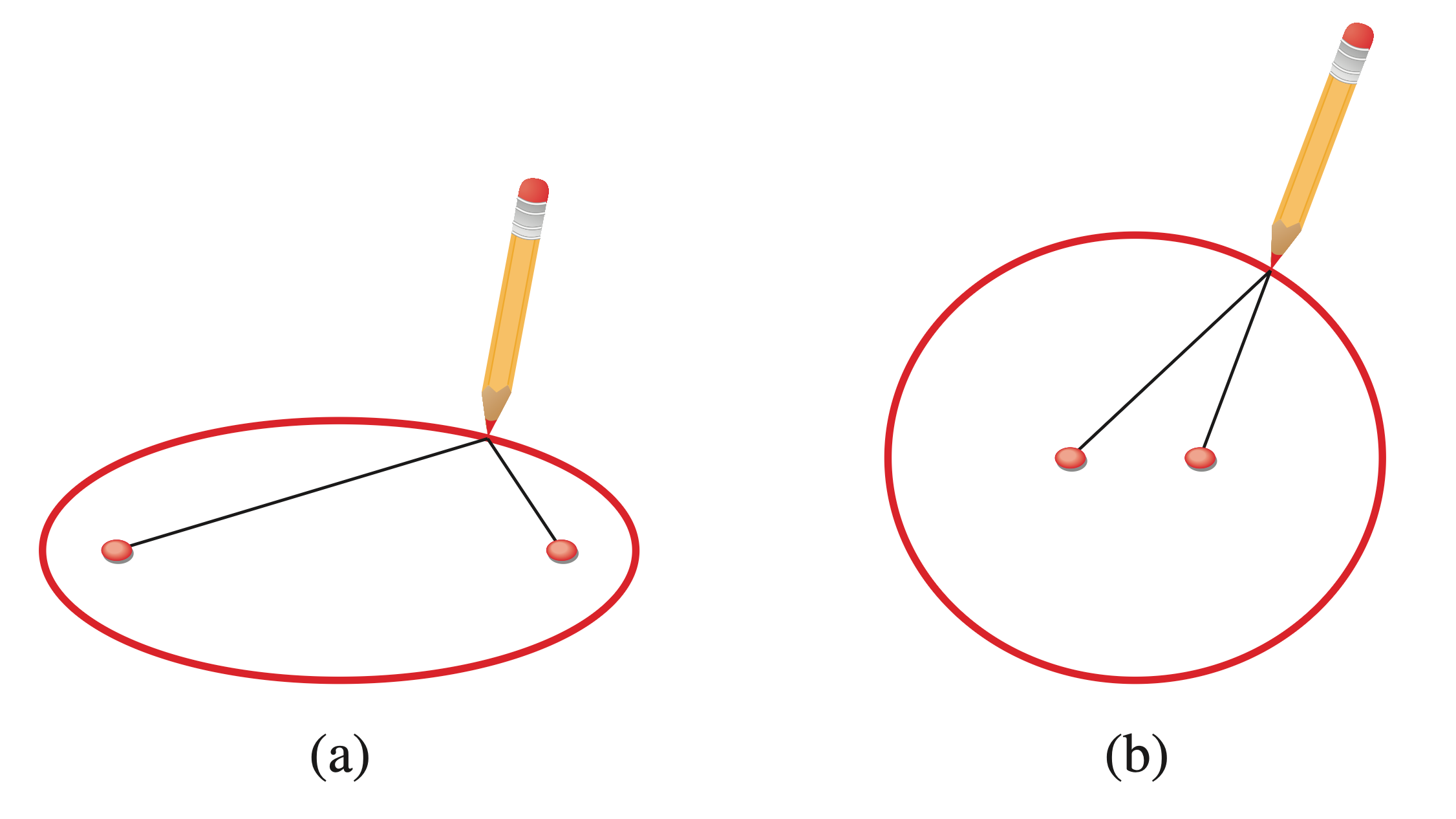
An ellipse is the set of all points in the plane the sum of whose distances from two fixed points and is a constant. These two points are the foci of the ellipse. Generally, an ellipse is an oval curve that looks like an elongated circle, unless the foci are too close together relative to the length of the string, that is, the sum is much greater than the distance between the foci, then the ellipse will look almost circular:
In fact, if the two foci are the same point, we get a circle, which is a special case of the ellipse. To get the simplest equation of an ellipse and for convenience, we place the foci on the axis at and , with the origin being halfway between them, and let the sum of the distances from a point on the ellipse to the foci to be , that is,
Thus we have
To simplify, we isolate one of the radicals then square both sides:
Repeat the same idea to eliminate the remaining radical:
Notice that to form the ellipse, the sum must be larger than the distance between the foci, that is, , or , thus . The equation is then simplified to
For convenience, we write the standard equation of an ellipse as
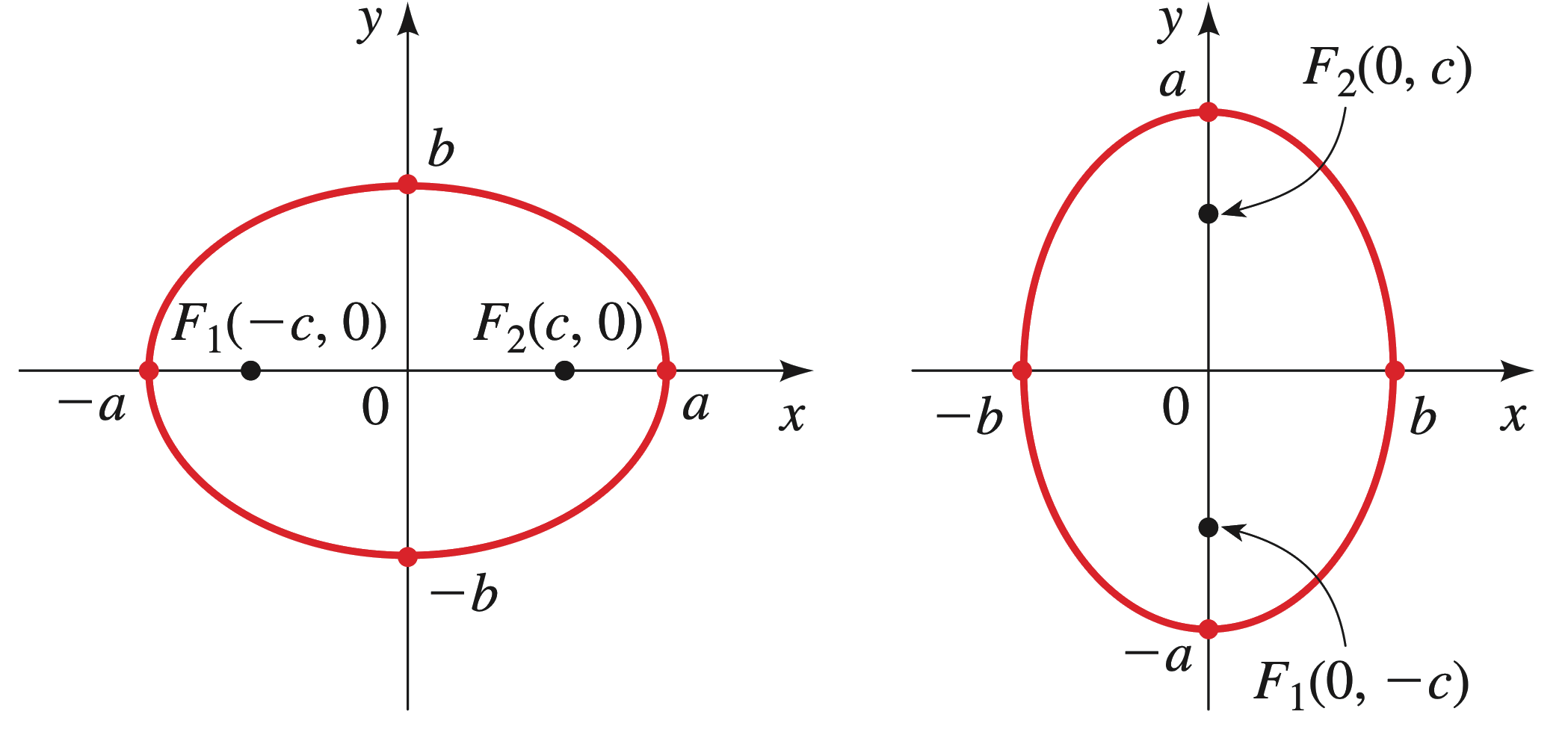
where , the foci are at and the center is at the origin. Setting , we get , thus the ellipse crosses the axis at and . These points are called the vertices of the ellipse, and the segment that joins them is called the major axis with length which is equal to the sum of the distances from any point on the ellipse to the foci. Setting , we get , so the ellipse also crosses the axis at and . The segment that joins them is called the minor axis with length .
If the foci of the ellipse are placed on the axis at instead, we get a vertical ellipse with vertices and equation . The graphs of the standard equation of an ellipse and a vertical ellipse are shown below.
Eccentricity of an Ellipse
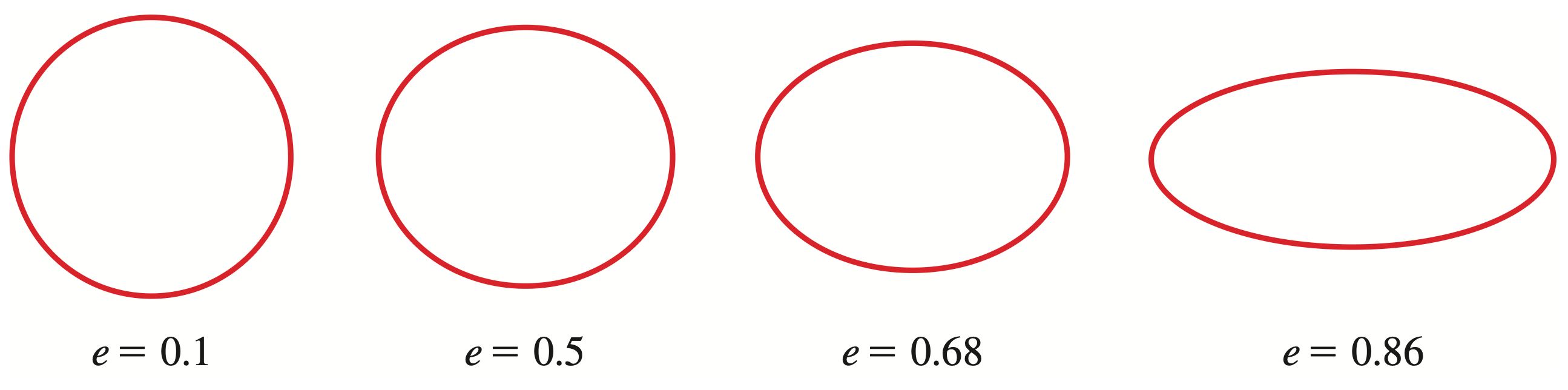
As discussed earlier, if is much greater than , the ellipse is almost circular. The eccentricity is the number
which measures the deviation of an ellipse from being circular. Since for every ellipse, the eccentricity satisfies . If is close to , then the ellipse is elongated in shape; if is close to , the ellipse is close to a circle in shape. The below figure demonstrates this idea.
Hyperbola
On the other hand, a hyperbola is the set of all points in the plane, the difference of whose distances from two fixed points and is a constant. These points are the foci of the hyperbola. Similarly, to get the simplest equation of a hyperbola, we place the foci at and let the difference of the distances between any point on the hyperbola to the foci to be the positive constant . Thus by definition,
or
which simplifies to
Notice that , or , thus we set to write the standard equation of a hyperbola as
with foci at . Note that by definition and are both positive and . The intercepts , obtained by setting , and the points are the vertices of the hyperbola, similar to an ellipse. However, there is no intercept since there is no solution for . Furthermore, from the equation we see
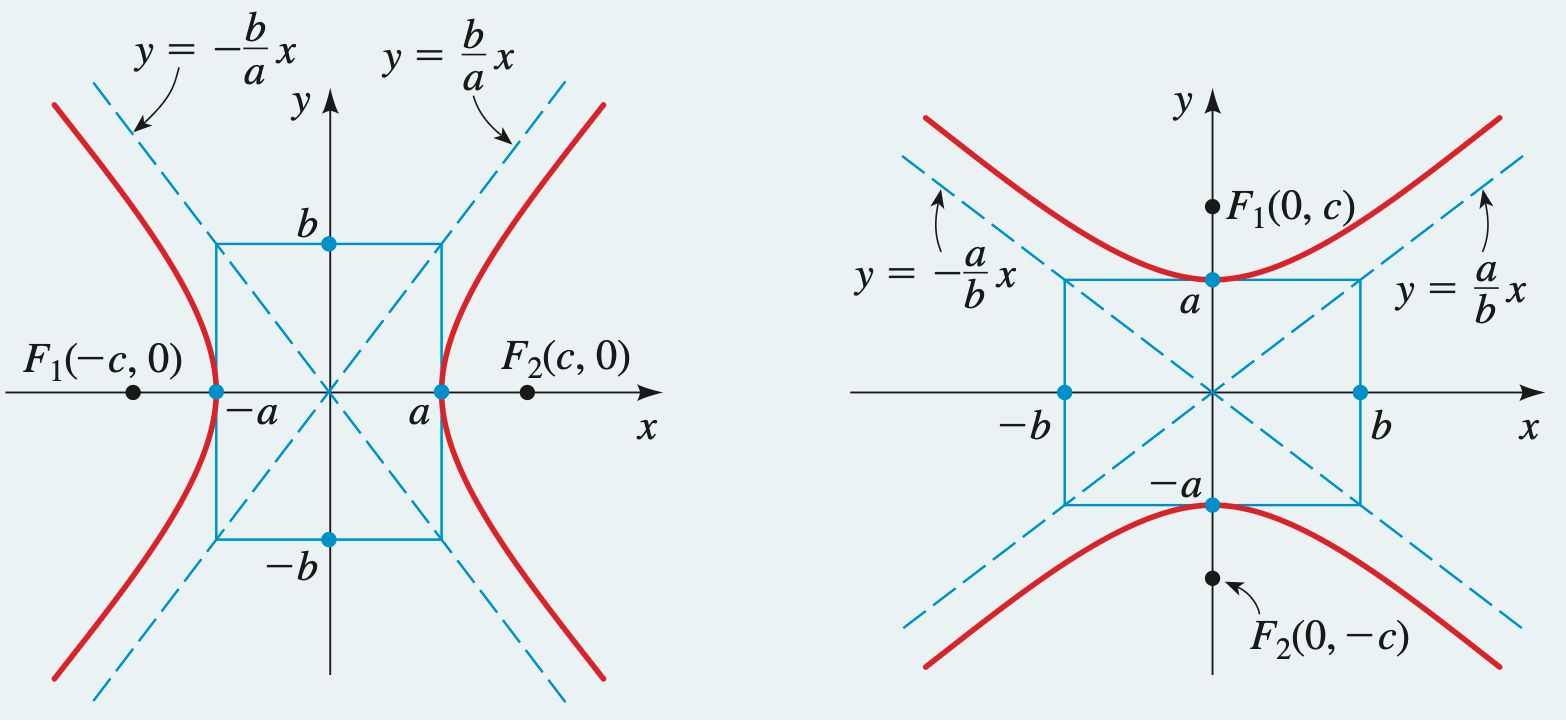
Thus or . These two parts are called the branches of the hyperbola. The segment joining the two vertices is the transverse axis with length . Similarly, interchanging and leads to a hyperbola with a vertical transverse axis and foci at which has the equation . The graph of each equation are shown below.
The fact that these hyperbolas are symmetric about both the and axes can be verified by the equations. To find the asymptotes, we solve the standard equation of a hyperbola for to get
which shows that as , , confirming the lines shown in the graph are asymptotes of the hyperbola. The rectangle centered at the origin from the above figure is called the central box with sides parallel to the axes, that crosses one axis at and the other at . The asymptotes are then simply the lines obtained by extending the diagonals of the central box.
Asymptotes and the central box are essential aids for graphing a hyperbola. We first plot the points regarding and to construct the central box, then obtain the asymptotes by extending the slopes of the diagonals.
General Equation of Conics
Recall the transformations of functions have the effect of shifting their graphs. Generally, the graph of any equation in and can be shifted in a similar fashion. If and are positive real numbers, how each of the following replacements shift the graph is listed below:
For example, if we shift the graph of an ellipse in standard equation so that its center is at the point , that is, the graph is shifted right and upward, the shifted ellipse has the equation .
If we expand and simplify the equations of any shifted conics, we always obtain an equation of the form
where and are not both . Conversely, we can complete the square in and to see which type of conic section the equation represents, and in some cases, the graph of the equation turns out to be a pair of lines or a single point, or there might be no graph at all. These cases are called degenerate conics. In the nondegenerate cases, the graph is
a parabola if or is .
an ellipse if and have the same sign, or a circle if .
a hyperbola if and have opposite signs.
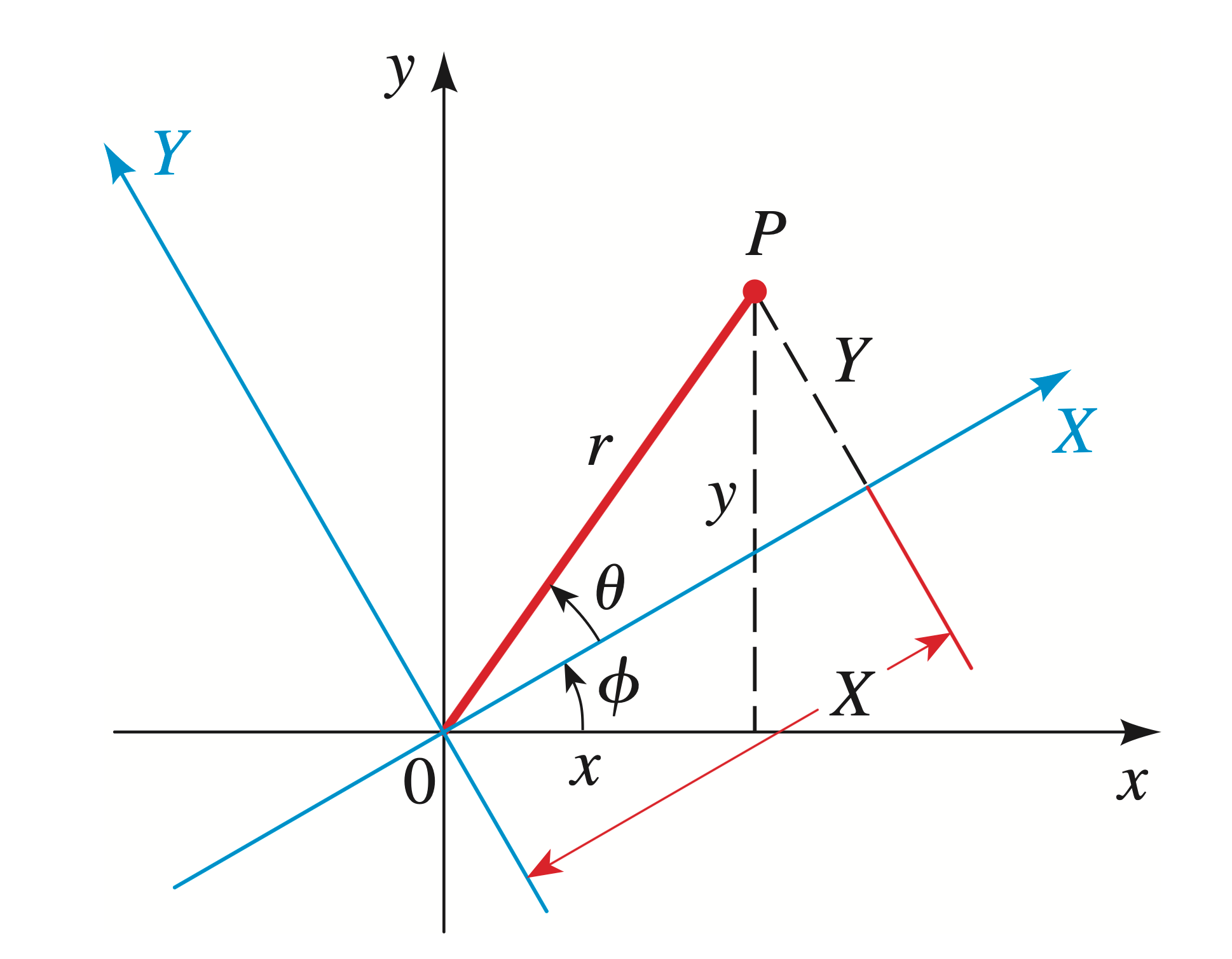
Consider a new pair of axes produced by rotating the and axes through an acute angle about the origin which we call the and axes. Let be the distance of a point which has coordinates in the old system, from the origin, and let be the angle that the segment makes with the axis, as illustrated below.
We see that
which can also be used to solve for and :
For example, we can show the graph of the equation is a rotated hyperbola by using the above formula with to obtain
which shows
This is recognized as a hyperbola with vertices in the coordinate system. Its asymptotes are which correspond to the coordinate axes in the system.
In fact, we can transform any general equation of a conic of the form
into an equation in and that doesn’t contain an term by choosing an appropriate angle of rotation. It can be shown by substituting and that to eliminate the term, rotate the axes through the acute angle that satisfies
to get an equation of the form
It can also be shown that the expression remains unchanged for any rotation, so if we choose a rotation that eliminates the term, that is, , in the nondegenerate cases the graph of the equation in the coordinate system is
a parabola if because either or is zero
an ellipse if because and have the same sign
a hyperbola if because and have opposite signs
The quantity is the discriminant of the equation which is also said to be invariant under rotation.
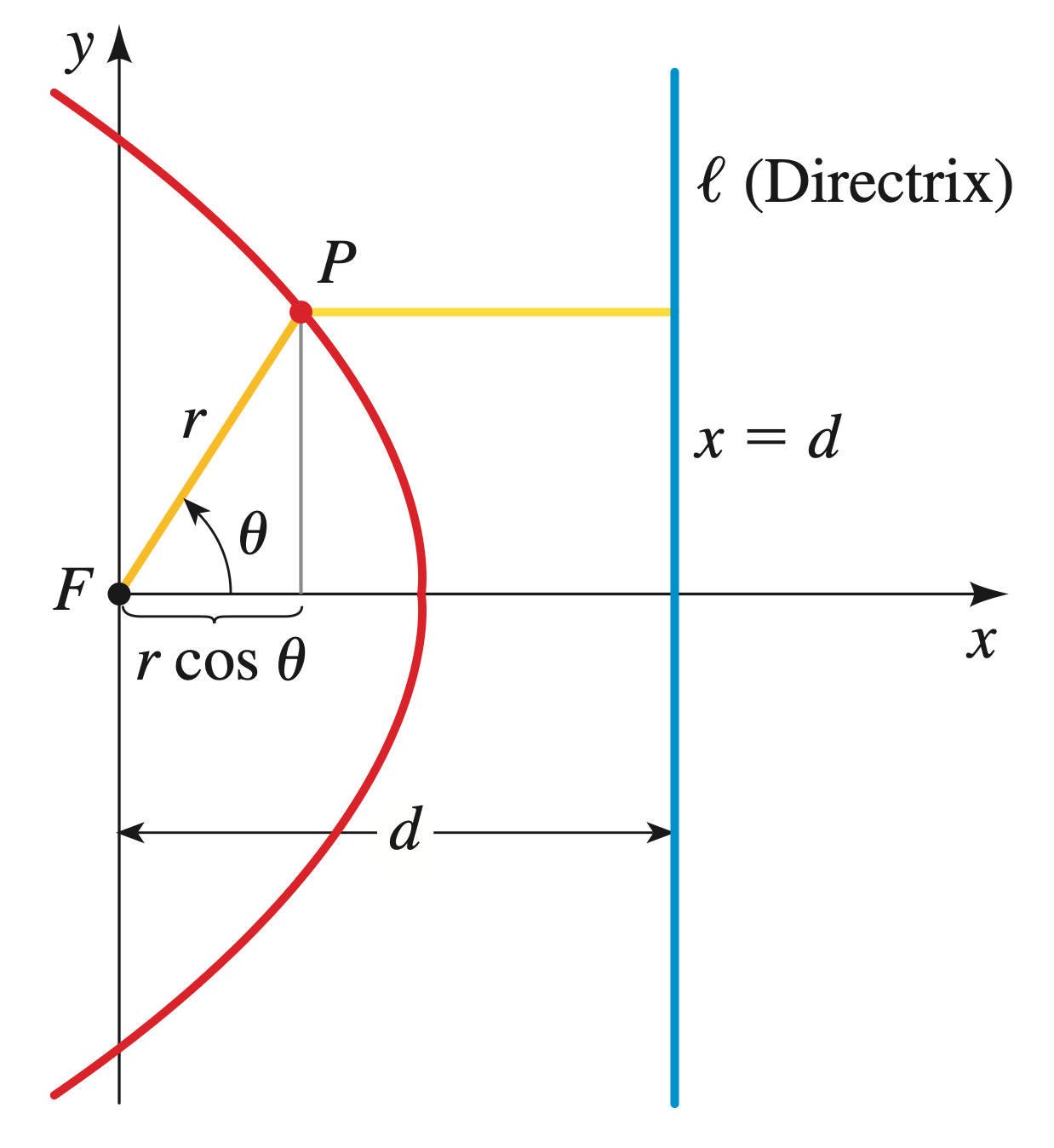
We now try to give a more unified description of all three types of conics in terms of a focus and directrix. Let be the focus placed at the origin and the directrix, and let be the eccentricity. The set of all points such that the ratio of the distance from to to the distance from to is the constant is a conic. That is, the set of all points such that
is a conic. A parabola always has by definition. Now, suppose and the directrix has equation , that is, the directrix is parallel to and units right to the axis and that point has polar coordinates , as illustrated.
We have
Solve for to get
If instead the directrix is chosen to be on the left of the focus, that is, , then , so . Similarly, if the directrix is parallel to the axis, that is, or , then we get instead of in the equation. To summarize, a polar equation of the form
represents a conic with one focus at the origin and with eccentricity . The conic is an ellipse if and is a hyperbola if .
Sequences and Series
A sequence is a list of numbers in which the numbers are often written as , call it function whose domain is the set of natural numbers. The terms of the sequence are the function values , or simply instead of , which is called the th term. For example, the sequence
can be described by the formula or by the recursive formula
Although the graph of every sequence consists of isolated points that are not connected, it is still often useful to graph them.
Finding patterns is an important part of mathematics. When given first few terms, we are interested in finding an obvious sequence which agree with them. For example, to find the th term of a sequence whose first several terms are given by , we notice the numbers are powers of and alternate in sign, so a sequence that agrees with these terms is given by . On the other hand, some sequences do not have simple defining formulas. For example, there is no known formula for the sequence of prime numbers:
Or, it may be that the th term of a sequence depend on some or all of the terms preceding it. A sequence defined in this way is called recursive. For example, the Fibonacci sequence is given by
and its first few terms are
The sequence named after the th century Italian mathematician occurs in numerous applications in nature such as the breeding of rabbits and the branching of a tree. On a side note, the ancient Greeks considered a line segment to be divided into the golden ratio if the ratio of the shorter part to the longer part is the same as the longer part to the whole segment, that is, , leading to . The ratio of two successive Fibonacci numbers gets closer to this value the larger the value of .
Adding the terms of a sequence leads to the definition of the partial sums of a sequence. For the sequence , the partial sums are
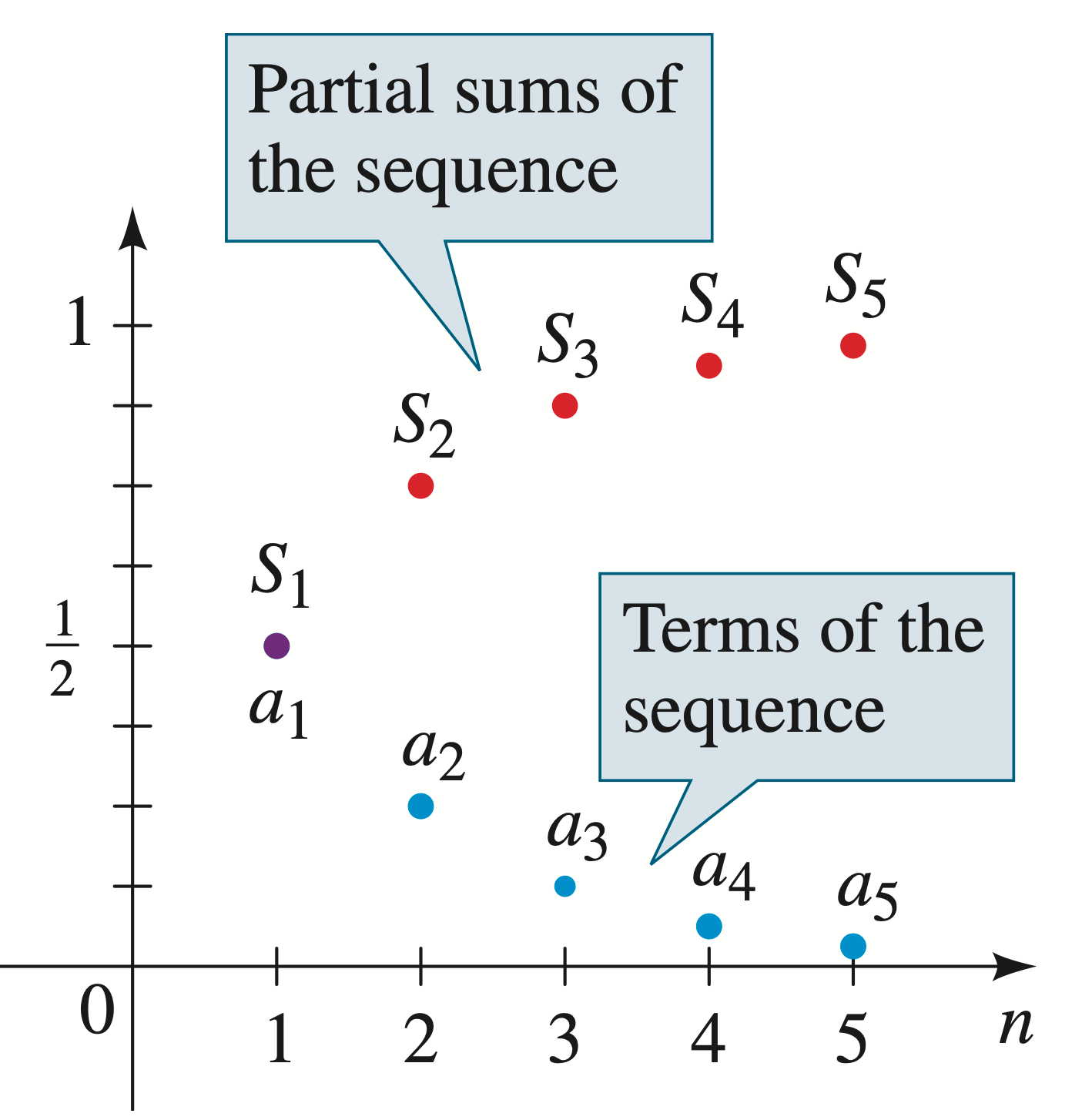
is called the th partial sum. The sequence is the sequence of partial sums. For example, consider the sequence given by . The terms of the sequence are , the partial sums are . In general, the th partial sum is . Below figure graphs the first few terms of and , which shows as , and .
We can also write the partial sums using summation notation, or sigma notation, which derives its name from the Greek letter , the capital sigma, corresponding to the for “sum”:
where is the index of summation. The left side of the expression is read, “The sum of from to “. If we replace the by , that is, the above expression becomes
it is then called an infinite series. In general, if gets close to a finite number called the sum of the infinite series, as gets large, we say the infinite series converges (or is convergent), otherwise the series diverges (or is divergent).
Arithmetic Sequences
An arithmetic sequence is generated by repeatedly adding a common difference to the starting number or initial term , in the form of
The th term of an arithmetic sequence is given by
We would then want to find the sum of the first terms of the arithmetic sequence whose terms are ; that is, we want to find
The idea is that since we are adding numbers produced according to a fixed pattern, there must also be a pattern for finding the sum. We begin by writing the sum in reverse:
Notice that
Thus the th partial sum of the arithmetic sequence is given by
The last formula says the sum is the average of the first and th terms multiplied by , the numbers of terms in the sum.
Geometric Sequences
A geometric sequence is generated by repeatedly multiplying the starting number or initial term by a fixed nonzero constant , called the common ratio, since the ratio of any two consecutive terms of the sequence would be , in the form of
The th term of a geometric sequence is given by
To find a formula for the th partial sum of a geometric sequence
we multiply by to get
Then intuitively
To summarize, the th partial sum for the geometric sequence defined by is given by
Notice that if ,
thus we conclude an infinite geometric series converges and has the sum if . On the other hand, if , the series diverges, intuitively.
Mathematical Induction
We add more and more of the odd numbers as follows:
and notice that the sum of the first odd numbers seem to be . However, we cannot conclude by checking a finite number of cases that a property is true for all numbers. Even though we feel fairly confident, we can still only make a conjecture:
or more precisely, to write the statement as
for all natural numbers . It is important to realize this is still a conjecture. What we need is a proof–a clear argument that demonstrates the truth of a statement beyond doubt. We often use a special kind of proof called mathematical induction. Let be the statement we made:
To prove for all , and in this case, for all natural numbers, the idea of mathematical induction is that, suppose we can prove that whenever one of them in true, then the one following it is also true. In other words,
This is called the induction step. The principle of mathematical induction is that if both the induction step and are proved, then is proved for all . To prove the induction step, we assume is true without proving it. The assumption is called the induction hypothesis.
is simply which is of course true. To prove the induction step, we should assume that
is true, then use this to show is also true, that is, to show
is true. We start with the left-hand-side and use the induction hypothesis to obtain the right-hand-side of the equation:
Thus follows from , we have proved the induction step. We now conclude by the principle of mathematical induction that is true for all natural numbers .
The formulas for the sums of powers are also proved by using mathematical induction. For example, to prove , again, we let state the expression and assume is true, then show
That is, follows from , thus is proved. The below formulas are proved in the same way.
We show that
Let us look at another example of proving the inequality for all by mathematical induction. Let denote , is the statement that , which is true. We assume , then show that
The Binomial Theorem
A binomial is an expression of the form . Suppose we can find a pattern in the expansion of for any natural number , we first look at the first few cases:
Intuitively we see that
There are terms, the first being and the last being .
The exponents of decrease and the exponents of increase from term to term.
The sum of the exponents of and in each term is .
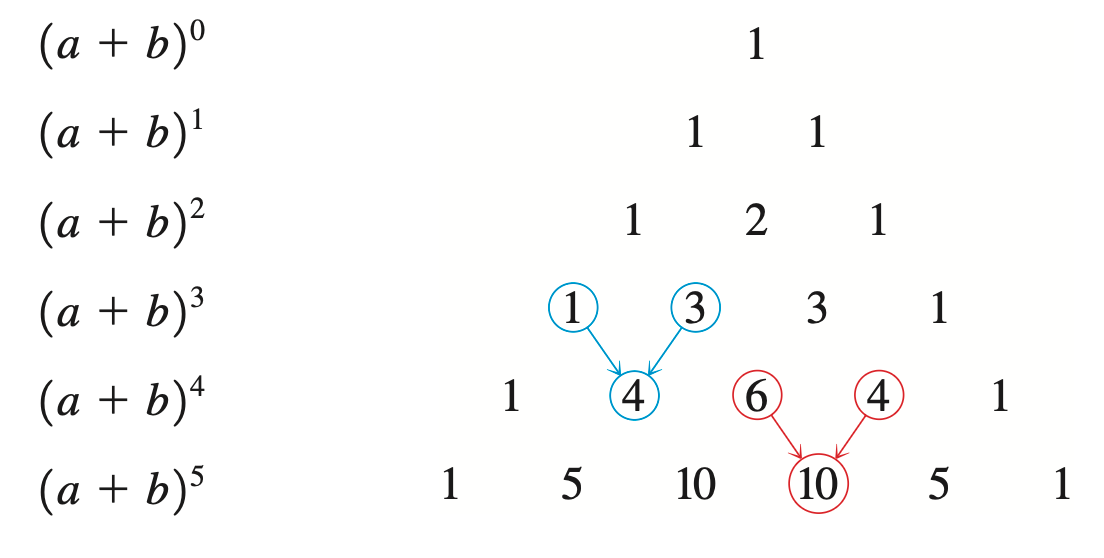
With these observations we can only write the form of the expansion of for any natural number , that is, the coefficients of the terms are yet to be determined. To find a pattern for the coefficients, we write them in a triangular array called the Pascal’s triangle, as shown below.
The corresponding is called the zeroth row and is included to show the symmetry of the array. We observe that every entry is the sum of the two entries diagonally above it. This is the key property of Pascal’s triangle. This method is however not practical for larger values of since it is recursive.
The product of the first natural numbers is called factorial, denoted by :
For convenience, we also define . The binomial coefficient is denoted by and is defined by
where , are nonnegative integers with . Notice that
and the identities
The latter identity is the key property of the binomial coefficients which is essentially a restatement of the key property of Pascal’s triangle in terms of the binomial coefficients.
is always a natural number, we use mathematical induction to prove this. Let denote the statement
is true because . We assume that is an integer for , and show using the key property that
which is clearly an integer since and are both integers.
We now state the Binomial Theorem and prove it using mathematical induction:
Let denote the statement, and verify
which is certainly true. We assume is true, that is,
is true, then show that
We conclude the binomial theorem is true for all natural numbers . The theorem can be used to find a particular term of a binomial expansion, the term that contains in the expansion of is .